In this lesson
- The whole idea in one line
- Step 1: decide the money you risk
- Step 2: measure the distance to your stop
- Step 3: find what 1.00 lot loses over that distance
- Step 4: divide, then round down
- Same risk, different stops
- When the quote currency is not dollars
- Where to find the numbers in MT5
- The smallest lot can be too big
- Three mistakes that break the math
- Why this matters even more at a prop firm
- Try it on your own trade
- Key takeaways
- Questions
Ask ten new traders how they choose their lot size and most will say something like "I usually trade 0.10" or "it depends how confident I am." Both answers have the same problem: the lot size came first, and the risk is whatever it turns out to be.
Professional traders do it the other way round. They decide how much money they are willing to lose, they look at where the stop has to go on the chart, and only then do they work out the lot size that connects the two. The lot size is the last number, not the first.
Think of it as a seesaw. On one side sits the money you decided to risk. On the other side sits your position size. The distance to your stop is what decides how heavy each lot is, so when the stop moves further away, the lot size has to come down to keep the seesaw level.
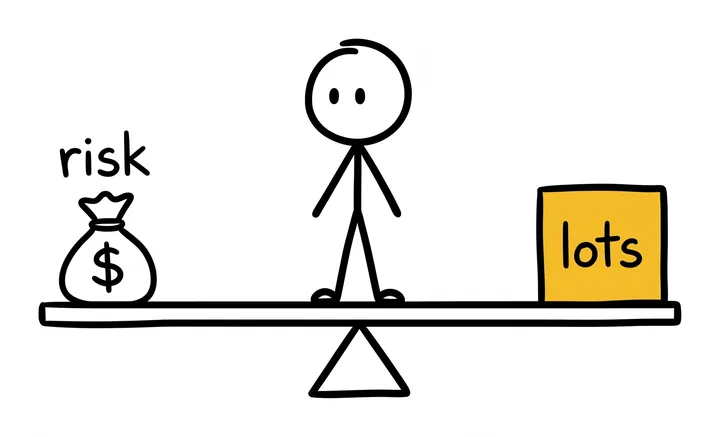
The whole idea in one line
Lot size = money you risk ÷ what 1.00 lot loses if the stop is hit
That is all of it. Everything else in this lesson is about finding the two numbers on the right correctly, because that is where traders make their mistakes.
We will walk through it in four steps with one example, then repeat it for other kinds of symbols.
Step 1: decide the money you risk
Start from your account, not from the chart. Lesson 2 covers how to choose the percentage. For this lesson we will use a $10,000 account and a risk of 1% per trade, which is $100.
That $100 is now fixed. Whatever the chart looks like, the trade must lose $100 or less if it goes wrong.
Step 2: measure the distance to your stop
Now go to the chart and decide where your stop belongs. It should sit at a price that proves your idea wrong, for example just beyond a recent swing low for a buy. Lesson 4 is all about where to place it.
Then measure the distance from your entry to that stop.
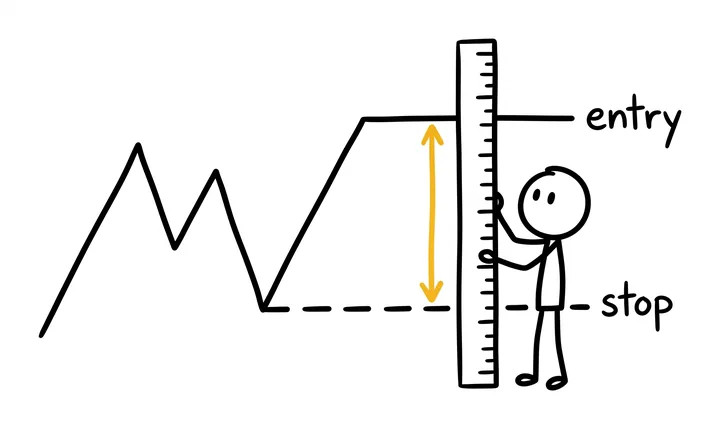
Say you want to buy EURUSD at 1.17000 with a stop at 1.16750. The distance is 0.00250 in price, which traders call 25 pips.
Pips and points are not the same thing
This is where many lot size mistakes begin, so it is worth a minute.
For most currency pairs, a pip is the fourth decimal place (0.0001). For yen pairs it is the second decimal place (0.01). But MetaTrader 5 quotes most pairs with one extra digit, and it measures distances in points, which are that last, smaller digit.
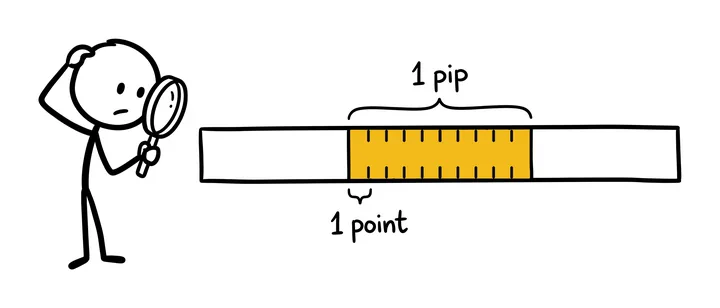
On a five-digit EURUSD quote, 1 pip is 10 points. So the 25-pip stop above shows up in MT5 as 250 points. Always check which unit your calculator or your EA setting expects. Mixing them up makes your position exactly 10 times too big or too small, and we will see what that costs in a moment.
Step 3: find what 1.00 lot loses over that distance
A standard lot of EURUSD is a contract of 100,000 euros. Because the price is quoted in dollars, every pip of movement is worth $10 on 1.00 lot.
So on our 25-pip stop, 1.00 lot loses 25 × $10 = $250.
Step 4: divide, then round down
$100 ÷ $250 = 0.40 lots.
If the stop is hit, 0.40 lots lose exactly $100, which is the 1% you planned.
When the answer is not a clean number, always round down to your broker's volume step, which is usually 0.01 lot. Rounding up quietly risks more than you decided. Rounding down risks a few cents less, which nobody has ever regretted.
The same four steps, every time
- Money you risk: $100.
- Stop distance: 25 pips.
- What 1.00 lot loses there: $250.
- $100 ÷ $250 = 0.40 lots, rounded down.
Same risk, different stops
Here is the part that changes how people trade once they see it. Keep the risk at $100 and only move the stop:
| Stop distance | Lot size | Money lost if the stop is hit |
|---|---|---|
| 10 pips | 1.00 | $100.00 |
| 20 pips | 0.50 | $100.00 |
| 40 pips | 0.25 | $100.00 |
| 80 pips | 0.12 | $96.00 |
Lot sizes rounded down to 0.01.
A tight stop lets you trade a bigger position. A wide stop forces a smaller one. In every row the dollar risk stays about the same, which is the whole point: your stop decides where you are wrong, and your lot size makes sure being wrong always costs the same amount.
Notice the last row too. At the widest stop, the exact answer falls between two lot steps, so it rounds down and the real risk ends up a little under $100.
When the quote currency is not dollars
The EURUSD example was easy because the pair is quoted in dollars, the same currency as the account. When the second currency in the pair is something else, one pip is worth a different amount of dollars, and you have to convert.
USDJPY: the yen pair
For yen pairs a pip is 0.01, and its value comes out in yen. On 1.00 lot (100,000 dollars of USDJPY), one pip is 1,000 yen. To turn that into dollars, divide by the price. At 158.00, one pip on 1.00 lot is worth $6.33.
Say you buy at 158.000 with a stop at 157.700, which is 30 pips. One lot loses $189.87 over that distance. So:
$100 ÷ $189.87 = 0.52 lots (rounded down), and the real risk is $98.73.
EURGBP: a cross pair
EURGBP is quoted in pounds, so one pip on 1.00 lot is worth 10 pounds. To get dollars, multiply by the GBPUSD rate. Say GBPUSD is 1.33. Then one pip is worth $13.30.
With a 30-pip stop, one lot loses $399, so you trade 0.25 lots and risk $99.75.
Gold (XAUUSD)
Gold is quoted in dollars, but its contract is not 100,000 units. At many brokers one lot of XAUUSD is 100 ounces, so a $1 move in the gold price is worth $100 on 1.00 lot. Your broker may use a different contract size, so check it (see below).
If your stop is $7.50 away from your entry, one lot loses $750. So you trade 0.13 lots, and the real risk is $97.50.
| Symbol | 1.00 lot | 1 pip is | Worth on 1.00 lot |
|---|---|---|---|
| EURUSD | 100,000 EUR | 0.0001 | $10 |
| USDJPY | 100,000 USD | 0.01 | $6.33 (at 158.00) |
| EURGBP | 100,000 EUR | 0.0001 | $13.30 (GBPUSD 1.33) |
| XAUUSD | 100 oz (check yours) | price $1.00 | $100 |
Contract sizes are common values; your broker's Specification window has the real ones.
Where to find the numbers in MT5
You do not have to trust a table on a website, including this one. Your broker's own numbers are inside MetaTrader 5:
Check a symbol in MT5
- Open Market Watch (Ctrl+M).
- Right-click the symbol and choose Specification.
- Read the contract size, the minimal volume and the volume step.
The contract size tells you how big 1.00 lot really is at your broker. The minimal volume and volume step tell you the smallest position you can open and how finely you can round.
The smallest lot can be too big
Small accounts hit a wall that big accounts never see. Say your account is $500 and you risk 1%, which is $5. Your EURUSD setup needs a 80-pip stop.
One lot would lose $800 at that stop. The smallest position most brokers allow is 0.01 lot, and even that loses $8, more than your whole planned risk. The formula gives you 0.00 lots, which means: this trade does not fit your account.
You have three honest options:
- Skip the trade and wait for a setup with a tighter natural stop.
- Trade a symbol or broker with smaller contract sizes, if you have one.
- Accept that this trade risks more than your plan, and decide that on purpose, before you click, not after.
The option that is not on the list is quietly opening 0.01 lot and pretending it fits.
Three mistakes that break the math
1. Mixing up pips and points
Take the EURUSD trade from above: 25 pips, or 250 points.
- If you type 250 into a calculator that expects pips, it thinks your stop is 10 times wider and gives you 0.04 lots. You are risking a tenth of your plan.
- If you type 25 into a field that expects points, it thinks your stop is 10 times tighter and gives you 4.00 lots. When the stop is hit, you lose $1,000, ten times your plan, on a single trade.
The second mistake is the dangerous one, and it is easy to make on a phone at the end of a long day.
2. Forgetting the quote currency
A pip is $10 per lot on EURUSD, but $6.33 on USDJPY at 158.00 and $13.30 on EURGBP with GBPUSD at 1.33. Traders who use "one pip is ten dollars" for every pair are taking different risks on every trade without knowing it.
3. Using the same lot size for every trade
If your lot size never changes, your risk changes with every stop you place. A 0.50-lot trade with a 10-pip stop and a 0.50-lot trade with a 40-pip stop are not the same trade. The second one risks four times as much.
Why this matters even more at a prop firm
Prop firm limits are counted in money, so lot size is what decides how many losing trades you get. On a $100,000 account with a $5,000 daily loss limit, risking $1,000 per trade means just 5 full losses end your day, and at some firms your account. Every firm counts this differently, so check the exact numbers in our prop firm rules pages.
Try it on your own trade
Our free lot size calculator does the four steps for you. You enter your balance, your risk and your entry and stop prices. It rounds down to 0.01 lot and converts cross pairs with the European Central Bank's reference rate. It also tells you how many losses like that would fill a prop firm's daily limit.
Key takeaways
- Lot size is the last number you decide: money you risk ÷ what 1.00 lot loses at your stop.
- On EURUSD, a 25-pip stop with $100 at risk gives 0.40 lots, because 1.00 lot loses $250 there.
- A wider stop means a smaller position, so the money at risk stays the same.
- A pip is not worth the same on every pair: $10 on EURUSD, $6.33 on USDJPY at 158.00, $13.30 on EURGBP with GBPUSD at 1.33.
- In MT5, 1 pip on a five-digit pair is 10 points. Mixing them up makes the position 10 times too big or too small.
- Always round down to the volume step, and skip trades where even 0.01 lot risks more than your plan.
Questions
How do I calculate lot size for a forex trade?
Divide the money you are willing to lose by what 1.00 lot would lose if your stop is hit. On EURUSD, with $100 at risk and a 25-pip stop, 1.00 lot loses $250, so the lot size is 0.40.
How much is one pip worth on 1.00 lot?
It depends on the pair. On pairs quoted in dollars, such as EURUSD, one pip on 1.00 lot is $10. On USDJPY at 158.00 it is $6.33, and on EURGBP with GBPUSD at 1.33 it is $13.30.
What is the difference between a pip and a point in MT5?
On most five-digit currency quotes, a pip is the fourth decimal (0.0001) and a point is the fifth, so 1 pip equals 10 points. MT5 measures distances in points, so a 25-pip stop shows as 250 points.
How do I calculate lot size for gold (XAUUSD)?
Check your broker's contract size first. If one lot is 100 ounces, a $1 move is worth $100 on 1.00 lot. With a $7.50 stop, 1.00 lot loses $750, so risking $100 gives 0.13 lots after rounding down.
Should I round lot size up or down?
Down, to your broker's volume step (usually 0.01 lot). Rounding up risks more than you planned. If even the smallest allowed lot risks more than your plan, the trade does not fit your account.
Risk management and position size
- 1. Why risk comes first
- 2. How much to risk per trade soon
- 3. Lot size, step by step
- 4. Where to put your stop-loss soon
- 5. Risk-reward and win rate soon
- 6. Losing streaks: what is normal soon
- 7. Daily loss limits and max drawdown soon
- 8. When two trades are really one soon
- 9. Build your risk plan soon
Educational content, not financial advice. Trading forex and CFDs carries a high risk of losing money. Examples use round numbers to show the method; check your own broker's contract specifications and your firm's rules.